 |
| Group photo of the 2015 ILR India GSL team and friends attending wedding in Mysore. |

Namaskāra! Join Cornell students from the ILR School taking part in a Global Engaged-Learning Program at the community development org Swami Vivekananda Youth Movement (SVYM.org) in Mysore, India. Students take courses in culture, labor, gender and public health and engage in service projects related to their studies. 2020 marked Cornell & SVYM 10th Anniversary!! For past years see archives. This opportunity is managed by International Programs in the ILR School.
Thursday, December 31, 2015
Saturday, August 1, 2015
Elyse '17 - Global Health - Diabetes Management at Kenchanahalli

Surrounded on all sides my rolling hills divided into bright patches of farmland, the tranquil setting of Vivekananda Memorial Hospital at Kenchanahalli is truly its own small world. Most of the staff lives on the campus, including three families, giving the hospital a true feeling of community, completely unlike anything that I have ever seen in the USA. All of the doctors who live on the campus are doctors of Ayurvedic medicine—traditional Indian medicine—with visiting allopathic physicians coming every weekday. My project this summer has been to develop patient education material describing the integrated approach of diabetes management using both ayurvedic and allopathic medicine. My project has enabled me to learn about a disease so common in the US, from the perspective of a completely different system. The ayurvedic physicians have taken so much time to explain the system of ayurveda to me, which depends on the balance of three doshas in the body. Several of the doctors here have taken the painstaking effort to translate Sanskrit texts on Mudhameha—or “honey urine”—the ayurvedic analog to diabetes. It has been fascinating to learn the modern problem of diabetes as it fits into a large and ancient body of knowledge. This has provided a striking contrast to the time I have spent shadowing allopathic physicians in the out patient departments at the hospital as they treat diabetic patients. Although the two systems often seem at odds, I have been impressed by the smooth and productive integration at VMH. My own contribution has been to combine instruction for diabetes management from both the Allopathic and Ayurvedic systems into a flashy, engaging Prezi, to catch patient’s attention.
In addition to the time spent on my project, my experience at Kenchanahalli has introduced me to some many other interesting aspects of medicine, health, and India. I have been fortunate enough to shadow OBGYN, orthopedists, ayurvedic, and general physicians in my time at VMH. This has given me a much deeper understanding of the successes and challenges faced in delivering health care to rural and tribal populations. I have also been able to explore my own interest in surgery by observing a hysterectomy at the larger SVYM hospital in Sargur. However, what I truly never expected was the way in which we have been welcomed into the family-like community here at Kenchanahalli. Learning to make chapati and gulab jamun, playing cricket, and even attempting to teach Mansi—the extremely hyper 8-year-old daughter of my mentor—some new English phrases, have been some of the most memorable moments of my time here.


Thursday, July 23, 2015
Alex '17 and Katherine '16 Global Health - GRAAM
Hello from the GRAAM office!

The Grassroots Research and Advocacy Movement (GRAAM) is a public policy research institute within the SVYM complex. GRAAM’s “commitment to building collaborative learning communities in the pursuit of human development” is driven by empirical evidence and experience in the field. The greatest focus of GRAAM is advocacy through the grassroots perspective for sustainable and real progress.
For our projects, we have been given the enriching experience of interning at the GRAAM office. For the next five weeks, Katherine will be working at the State Training Centre department of GRAAM. STRC is supported by the National Aids Control organization. The role of STRC is to strengthen the capacity of targeted intervention project staff, including peer educators, outreach workers, program managers and counselors, and to undertake operational research.
Katherine will be developing supplementary training manuals for the project staff, and accumulating additional research material to assist with the center’s ongoing research projects. Alexandra, on the other hand, will be focusing on community participation and engagement in health. This intervention strategy motivates the community and its representatives to directly implement, monitor, and evaluate public health services that address self-defined needs. This bottom-up approach empowers the community and indirectly provides an accountability framework ensuring government responsibility. Alexandra will be conducting research that will culminate in a case-study analysis and literature review paper that will assist GRAAM in future health intervention endeavors.
We are very excited to see what our projects have in store for us. We hope that these next few weeks will lead to development, professionally, academically and personally. SVYM has given us incredible opportunities and we are so grateful for this experience.
All the best,
Alexandra and Katherine
Global Health-GRAAM
For our projects, we have been given the enriching experience of interning at the GRAAM office. For the next five weeks, Katherine will be working at the State Training Centre department of GRAAM. STRC is supported by the National Aids Control organization. The role of STRC is to strengthen the capacity of targeted intervention project staff, including peer educators, outreach workers, program managers and counselors, and to undertake operational research.
Katherine will be developing supplementary training manuals for the project staff, and accumulating additional research material to assist with the center’s ongoing research projects. Alexandra, on the other hand, will be focusing on community participation and engagement in health. This intervention strategy motivates the community and its representatives to directly implement, monitor, and evaluate public health services that address self-defined needs. This bottom-up approach empowers the community and indirectly provides an accountability framework ensuring government responsibility. Alexandra will be conducting research that will culminate in a case-study analysis and literature review paper that will assist GRAAM in future health intervention endeavors.
We are very excited to see what our projects have in store for us. We hope that these next few weeks will lead to development, professionally, academically and personally. SVYM has given us incredible opportunities and we are so grateful for this experience.
All the best,
Alexandra and Katherine
Global Health-GRAAM
Wednesday, July 8, 2015
Viveka Tribal Centre for Learning, Katie L. ILR'17
While it
only takes one day to fall in love with the kids and staff in Hosahalli, I have
been lucky enough to spend two full weeks here. Since I started working, I have
been observing the ins and outs of this school Viveka Tribal Centre for
Learning. I have interviewed teachers, eaten alongside the students, toured
their dormitories, taken part in their after school activities and sat in on a
variety of classes covering multiple subjects, such as Kannada or Science, ranging
from 1st to 10th standard (or grade). By the very nature
of my project, I get to be a student, a teacher, an administrator, and an
outsider. I am observing the school’s routine through these different roles and
perspectives. More specifically, my project is a documentation of VTCL through
the lens of three separate case studies.
The first
case study looks at the building structure of the school and how it encompasses
VTCL’s philosophy. What’s particular about this school is the structure of an
open classroom. This classroom has no windows or doors but rather large square
openings to alleviate the feeling of constraint that comes from more formal
classrooms. The second case study is on the schedule and overall daily routine
of the school. I look at the attitude taken by teachers and students towards
their class schedule and compare it to its implementation. The third and last
case study takes a closer look at the children. Because VTCL prioritizes
education for tribal students, this case study assesses the kind of role their
specific tribe and background plays into their interactions with each other, if
at all.
My work
aside, the kids and staff have made me feel so welcomed. Whether it’s at tea
with the teachers or walking to lunch with the kids, everyone is so eager to
talk to you. Their friendliness is infectious and you can’t help but feel a
warm presence around the school. I have molded into such a comfortable routine
that the line between work and play has blurred. I look forward to going to
school, playing with the kids and talking to the teachers. As my time here is
starting to wind down, it’s getting more and more difficult to ignore that I
will have to eventually say goodbye. But while I may only get one month here,
Hosahalli will always continue to be my manne, my home.
 |
| Open classrooms for 5th – 8th standard students |
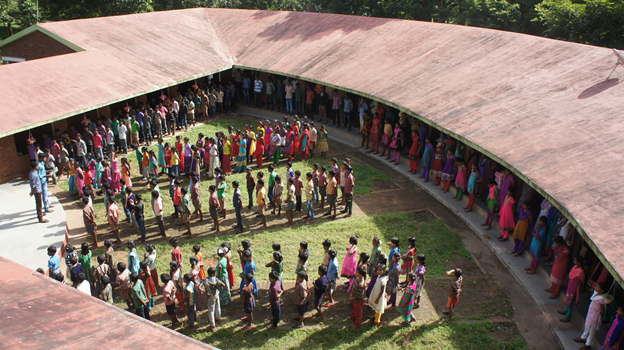 |
| Whole school gathered for the daily morning prayer before starting classes as a student reads the day’s newspaper in English. Students in “free dress” because it’s a Wednesday. |
 |
| Rachel and I with a few 10th standard students in front of their classroom |
 |
| 9th standard students taking English outside for the day’s lesson |
 |
| Aleks walking back from the girls’ dormitory with a few of the girls |
 |
| A painting done by one of the students Kala, 9th standard. Picture taken by Ravi, 6th standard. |

Wednesday, July 1, 2015
Report from the Hosahalli Resource Centre, Aleksandra ILR'17
The past
two weeks at Hosahalli Resource Centre have been enlightening to say the least.
The Centre is made up of two schools: Viveka Tribal Centre for Learning (VTCL),
which is the primary and high school for tribal children between the ages of
five and fifteen, and the Vivekananda Teacher Training Resource Centre (VTTRC),
which is a two year college program for future elementary school teachers.
So
far I have been gathering pictures and information about both schools to update
the VTTRC website and create a website for VTCL. During our free time, we
interact with the teachers and students and try to push past the limits of our
language barriers. The teachers are eager to learn about and compare the
American educational system to their own, while the students are curious about
our everyday lives, as well as taking as many pictures on our cameras as
possible. We have already learned a lot from each other, even through simple
exchanges of Kannada or English phrases.
As friendly and welcoming the
environment is it has its challenges as well. It is little hard for me to work
on a website with no web design background or connectivity to the Internet. I
have to force myself to think outside the box, and use the information and
resources I have wisely. This is much more easily said than done. Yet with such
friendly and appreciative mentors who stress the importance of enjoying our
work, it is hard not to do the best job possible. I have already learned much
more during my stay in India than I have contributed. This is motivating me to
provide the best services I can, regardless of my web development skills, in
return for such a welcoming and informative atmosphere.
 |
|
At the
Backwaters of the Kabini River Reservoir near the Hosahalli Resource Centre
|
 |
| With some of the VTCL students |
Tuesday, June 9, 2015
A Wedding Celebration

An Indian wedding celebration differs from one in the West in that invitations are extended to friends, both old and new. On the flight to Bangalore, Katherine met Vin, who was traveling to India for his brother's wedding. After a 9-hour flight, Vin extended an invitation to Katherine and her "friends" to attend his brother's wedding reception in Mysore (the first one was in Bangalore). Knowing that this would be a once in a life time opportunity, Katherine confirmed with Vin that she could invite 25+ of her friends, and then the preparations were in motion.

Mme. Sindhu and Sararose stopping at a flower stand to select an arrangement for
the bride and groom, Nikhila and Madhu.


A few days before the event, selecting a sari.

Sejal helping Maddie.

The tailor met the team at the shop to take measurements for the blouses, and then delivered 15 them in few days!

The day of the event, Mme. Sindhu helping the team with their saris.

Katie Q. attaching jasmine flowers.

Leaving the hostel.

Katherine meeting Vin and his family at the reception.
 |
| Extending our best wishes to the bride and groom, Nikhila and Madhu. |

After the formal greeting, enjoying a fabulous meal.
 |
| Each tent featured a different dish. |

Paan is a traditional after-dinner food, which aids in digestion after a large meal.

One last group photo after an amazing evening celebrating the union of Madhu and Nikhila!
Friday, June 5, 2015
GSL Article in The Hindu!
An article about GSL students studying at VIIS was in the The Hindhu. The photo is of Mr. Purshotham giving a lecture on Indian labor law.
Published: June 5, 2015 00:00 IST | Updated: June 5, 2015 05:53 IST Mysuru, June 5, 2015
Published: June 5, 2015 00:00 IST | Updated: June 5, 2015 05:53 IST Mysuru, June 5, 2015
Short-term courses in VIIS attract foreigners
 Students of Cornell University pursuing short-term course in labour laws at the Vivekananda Institute of Indian Studies in Mysuru.— Photo: M.A. Sriram
Institutes of higher learning in the United States of America (U.S.) may lure thousands of Indian students to its campuses every year. But, a few students from the U.S. are attracted to educational institutions in India.
However, Vivekananda Institute of Indian Studies (VIIS), which has been hosting students from U.S. Universities for its short-duration programmes, has seen the numbers reach a record high of 216 students during the year 2014-15 from just 107 when the initiative began in 2008-09.
Studying a variety of issues ranging from Indian culture, civilization and history to India’s labour laws and public health issues, the international students are not only exposed to academics, but also Indian culture and lifestyle during their short duration stay extending up to eight weeks.
Andy, a student of Cornell University, U.S., who is currently studying Indian labour laws, said his visit to a coffee plantation in Kodagu, where he interacted with the labourers, was a learning experience.
“I find labour laws more employee-friendly in India than in the United States of America.”, he added.
Sejal and Rana, also students of Cornell University, who will be studying public health during their stay here, will also take up projects of preparing health statistics of students of N. Ranga Rao Memorial School for Blind and fund raising for spastics.
Students, who had attended preparatory sessions before coming to India earlier this week, have begun relishing Indian dishes. “We like the variety of spread offered to us”, said Dawn, another student.
Importantly, students don’t mind eating with their bare hands, pointed out Donna M. Ramil, Associate Director of International Programs in Industrial and Labour Relations (ILR), Cornell University.
VIIS has tied up with 22 foreign universities, mostly in the U.S., to offer its students customised courses on a variety of topics including Indian economy, micro-finance, health aspects etc, said VIIS Director Sindhu Suresh.
“The West and East should share its expertise”, she said. If the West is known for its management culture, the East can offer its spirituality and values system, she added.
Thursday, June 4, 2015
Shravanbelagola and Belur Visits
Namaskara from Mysore, India!
 |
| The steps leading up to the temple. |
On Wednesday, we ventured an
hour and a half outside Mysore to Shravanbelagola, a Jain Temple. This
breathtaking temple can only be reached by climbing over 600 steps carved right
out of the mountain. More than the incredible view of Hassan, the top of the
mountain holds the magnificent Gomateshwara Statue, the world’s largest
monolithic stone sculpture.
 |
| The view of Hassan. |
 |
| The team with the statue of Gomateshwara. |
 |
| The Belur temple. |
 |
| Intricate carvings of dancers on the exterior walls of the temple. |
Our day captured the religious diversity
within India and successfully translated out classroom knowledge into reality.
It has been an amazing week and we cannot wait to update you more in the
future!
This is JaM (Jack and Maddie) signing off.
Sunday, May 31, 2015
Adjusting to the Spice
 |
| A scene from the road in Hebbal, Mysore, which is the neighborhood near our Hostel |
Hello Everyone!
Here’s a bit on our first
few days in India, although already we’ve done so much I feel like I’ve been
here much longer than that. Most of the group arrived safely here in Mysore,
and we’ve been settling in nicely since then.
The first order of business
on Friday was to go shopping for the appropriate attire for our stay here
(pictures definitely will speak for me on this one). Other than that, we got
our first view of the city, ate our first meals (spicy, but so good!...we’re
getting used to the flavors too) at the hostel, and got a quick glance of SVYM.
We also all experienced the extreme exhaustion that comes with such a long
trip.
 |
| The front of the palace during daytime |
On Saturday we had our
orientation, which began with a very nice ceremony welcoming us to SVYM. After
a tour of the campus, we participated in a lamp-lighting ceremony and listened
to words about SVYM’s mission as an organization. This part was especially
interesting to me as Madame Sindhu, our program coordinator, stressed that
India is at a “critical juncture” and that SVYM aims to catalyze India’s
development through the growth of human capital. Not only does this mission
statement resonate with me, but it also provides me with a deeper context for
the reason for my project.
 |
| The temple at Chamundi Hill |
Today the group toured
Mysore, and this was truly an amazing experience. We started the day at the
Mysore palace, where we learned not only the royal history of the city but also
the city’s relationship with the British and how it gained independence. The
palace was BEAUTIFUL, so beautiful in fact that we went back at night to see it
lit up. Again, pictures will do it more justice than I can with words.
We also visited St.
Philomena’s church and Chamundi Hill, at the top of which is a beautiful
temple. We watched an offering ceremony inside the temple and took advantage of
the spectacular views of Mysore from outside.
Before I sign off, I want to
mention an observation/thought (among many) I’ve had over the first few days:
why the sharp divide between wealth and poverty? I noticed it driving through Bangalore on the
way to Mysore and also a little bit here. I don’t know the answer, but through
the newer presence big industries, like Infosys in Mysore, my thoughts turn to
the need for high-skilled labor and the apparent lack of it. Does training in particular industries
contribute to wealth? Are there other avenues for upward mobility? I’m sure
there are tons of answers to this question, and I definitely hope to explore
them in classes (which start tomorrow!) these first two weeks).
 |
| A group of us in front of the palace, which is only lit up on Sunday nights |
Ok, that’s all for now!
All the best,
Abigail
Saturday, May 30, 2015
Meet the TAs!

Hi there! My name is Andy. I’m one of the TAs for this
year’s trip. I graduated this past May from the ILR School with minors in
Global Health and Music. I participated in this program as an undergraduate two
summers ago and worked with Palliative Care Mysore (http://www.vild.edu.in/?q=palliativecare)
on projects relating to their outreach video and income generation program for
patients and their families. I also worked in Lusaka, Zambia last summer
through another GSL program.
I am thrilled to be back in a country I love through a program that I believe
in strongly!
Subscribe to:
Posts (Atom)