Dr. P. K. Misra, one of our lecturers at SVYM, first pointed out to our group the way in which Indians view the utility of the fifteen feet of paved space between buildings. America, he stated, builds streets with the express purpose of channelling traffic from point A to point B in the most efficient manner. On the other hand, Indian roads serve as a gathering space for all types of transport and interaction. When I first walked with several of my friends to Hebbal, our local shopping district, I noticed a lack of street signs, traffic lights, and road signs, and an abundance of motorcycles, rickshaws, buses, cows with owners, cows without owners, sheep, stray dogs, and people. Instead of driving on the left or right side of the road, all forms of traffic meander peacefully through the obstacles created by the presence of others. While it remains somewhat unclear to me how exactly pedestrians are not killed by any of the aforementioned vehicles, I have found that simply by walking through any place along the edge of the street without making any sudden movements nearly guarantees safety against the whirr of zigzagging traffic. For me, a street is a place where people wait in an airtight metal box until they've reached their destinations. For India, the street is still not the destination, but it doesn't attempt to water down the journey with air conditioning and a backseat DVD player. It's a culture that doesn't try to escape its realities, harsh as they at times can be. That's the real ground between India and the America with which I'm familiar, and I'm glad to be navigating it – rickshaws, farm animals, stray dogs and all.
Namaskāra! Join Cornell students from the ILR School taking part in a Global Engaged-Learning Program at the community development org Swami Vivekananda Youth Movement (SVYM.org) in Mysore, India. Students take courses in culture, labor, gender and public health and engage in service projects related to their studies. 2020 marked Cornell & SVYM 10th Anniversary!! For past years see archives. This opportunity is managed by International Programs in the ILR School.
Friday, June 8, 2012
A Walk in India's Streets is a Walk in Her Shoes
Dr. P. K. Misra, one of our lecturers at SVYM, first pointed out to our group the way in which Indians view the utility of the fifteen feet of paved space between buildings. America, he stated, builds streets with the express purpose of channelling traffic from point A to point B in the most efficient manner. On the other hand, Indian roads serve as a gathering space for all types of transport and interaction. When I first walked with several of my friends to Hebbal, our local shopping district, I noticed a lack of street signs, traffic lights, and road signs, and an abundance of motorcycles, rickshaws, buses, cows with owners, cows without owners, sheep, stray dogs, and people. Instead of driving on the left or right side of the road, all forms of traffic meander peacefully through the obstacles created by the presence of others. While it remains somewhat unclear to me how exactly pedestrians are not killed by any of the aforementioned vehicles, I have found that simply by walking through any place along the edge of the street without making any sudden movements nearly guarantees safety against the whirr of zigzagging traffic. For me, a street is a place where people wait in an airtight metal box until they've reached their destinations. For India, the street is still not the destination, but it doesn't attempt to water down the journey with air conditioning and a backseat DVD player. It's a culture that doesn't try to escape its realities, harsh as they at times can be. That's the real ground between India and the America with which I'm familiar, and I'm glad to be navigating it – rickshaws, farm animals, stray dogs and all.
Friday, June 1, 2012
Wednesday, June 22, 2011
Reflection: Alyssa, BSILR'13
Week 1 Reflection, Alyssa:
| Alyssa with students at the Viveka School of Excellence in Saragur. |
Saturday, June 18, 2011
An Indian Wedding
Then we watched the ceremony begin where the bride and groome performed a series of rituals that tied their marital bond. We were each given the chance to individually go up on the stage and bless the bride and groome by pouring what looked like water, turmeric and milk on their hands, which were full with a mound of bananas and leaves. I am sure I can speak for us all and say that it was great to have been invited to this wedding because not only was it great to leave our project sites, but it gave us a chance to reunite and witness a piece of Indian culture in this great wedding season.
From left to right: Shannon, ILR'13; Aminatta, ILR'13; Samrawit, HE'13; Alexandra, ILR'13; Aarti, HE'13; and Chelsea, ILR'12.
From left to right: Kevin, ILR'13; Marko, ILR'13; Aarti; Aminatta; Samrawit; Shannon; Chelsea; Iowa grad students (3); Alexandra; Jessica, HE'13; and Henry, HE'12.
Wednesday, June 15, 2011
Namaste from Hyderabad! Alyssa and Marissa here! We spent our first day exploring the big city of Hyderabad and were again impressed by the beauty and history that our new home holds.
We started off our day going to Charminar (left) which was built in 1591 and translates to "Four Towers" in English. The famous structure was built to commemorate the elimination of a plague epidemic from this city.
Hyderabad is famous for a lot of things, one of which is BANGLES! Again, perfect for the two of us. We haven't bought any yet, but we are getting a good feel for prices. The famous place to get the best selection and best prices is right by Charminar.
After Charminar, we headed off to the Golkonda Ruins. If you look closely at the picture you can see the ruins in the bottom half of the picture, and part of the city above them. We remember being so confused because people kept clapping at the bottom of the ruins. At first, we thought they were trying to scare the birds off. It turns out, people were clapping because the clap and even talking can be heard at the very top of the ruins (where Marissa is in the picture). Apparently, the King would know when visitors had come because the servants would greet them at the right spot so that the noise carried directly to the top of the ruins. Below are more pictures from Golkonda.
Although we both greatly enjoyed exploring the wonders of Hyderabad, starting our first day of work was definitely the highlight of our time thus far. We are working for a public-private partnership called the Centre for Persons with Disability Livelihoods (CPDL). CPDL is an organization set up by the Society for Elimination of Rural Poverty (SERP) and the Wadhwani Foundation which enables people with disabilities to hone in on their skills and attain long-term sustainable employment. Most students go through 2-3 months of training during which time they also receive room and board, counseling, encouragement and inspiration. Between the government-run SERP and the privately-owned Wadhwani Foundation, all training and living accommodations come free of charge to these students.
We were honored to be able to meet all 40 students currently training at the center on our first day. We had the opportunity to sit down and ask questions and were so moved by hearing all of their dreams and aspirations. Many of these students come from families who live below the poverty line and freely express how thankful they are for this amazing opportunity. The program is intended for students between 18-32 years of age and has specialized training based on the students age, experience, educational level, and skill preferences. The ultimate goal is to place these individuals in sustainable careers where they can not only earn a living, but create a life. We learned so much just by sitting down and conversing with the students which really ignited our motivation and vision as we start our projects.
Tuesday, June 14, 2011
A Willingness to Learn
However, where I would be teaching Spoken English for the next two weeks is at the Vivekananda Teacher Training Research Center, a school comparable to a college in the United States. My students were between 19-25 years old (me being 20 years old myself!) so connecting with them on a personal level was a little bit easier. On the right is a picture of my students in the classroom, where they were all more than eager to learn both English and about the rest of the world. For the next two weeks, these will be my students. As much as I have to offer and teach to them, I know that I will learn just as much (if not more) from them!
Tuesday, June 7, 2011
A Trip to Reid & Taylor
Thursday, June 2, 2011
We're Not Sorry for Saris
Wednesday, June 1, 2011
Our First Days at SVYM
Before dinner we went out and played volleyball with some local kids who work at SVYM, and let me tell you they are pros. I was on the winning team but my skills paled in comparison to these guys and gals. Oh, and while playing the game the sun was setting and the sky was the astonishing. It was like rainbow sherbet but colossal and glowing. It also gets dark really quickly here, I guess I’m still not used to the sunlight at this latitude.
The classes are so interesting and are all so intertwined. Indian Culture and Philosophy is taught by Professor Rao who is so knowledgeable has been very involved in archaeology and historical research in India. He was the person whose name got us in to the VIP rooms of Mysore Palace! Professor Shanthi is teaching our class on gender relations in India. Her class has opened my eyes to the reality of gender inequality in this country and to the struggle that millions of Indian women face. I find her really inspiring. Us ILR students then take labor econ, while the global health students are taking a global health class (in the context of India). We had our first Kannada class today and it was a blast! We learned a bunch of basic phrases and our Professor is a riot, and is superb at engaging the class! Also Yoga classes started on Monday which is conducted before breakfast. If you haven’t tried yoga before I recommend doing so. It is such a great way to start your day!
We are sharing the SVYM hostel facilities with Students from other schools and organizations. There are about a dozen undergraduate students studying at SVYM for the semester from Mount Allison University (New Brunswick, Canada). We haven’t had any formal time to get to know one another so we are planning some sort of community event (still working on the specifics). There are also four graduate students who are interning with UNICEF. They are working as a team to study/ research the education of girls in India. We are also expecting some students from Iowa State University somewhere in the near future.
So far India has been a wonderful experience. Pretty excited for the rest of our time hear at SVYM’s campus. I just hope it doesn’t go by too quickly.
Friday, May 27, 2011
Students arrive in India!
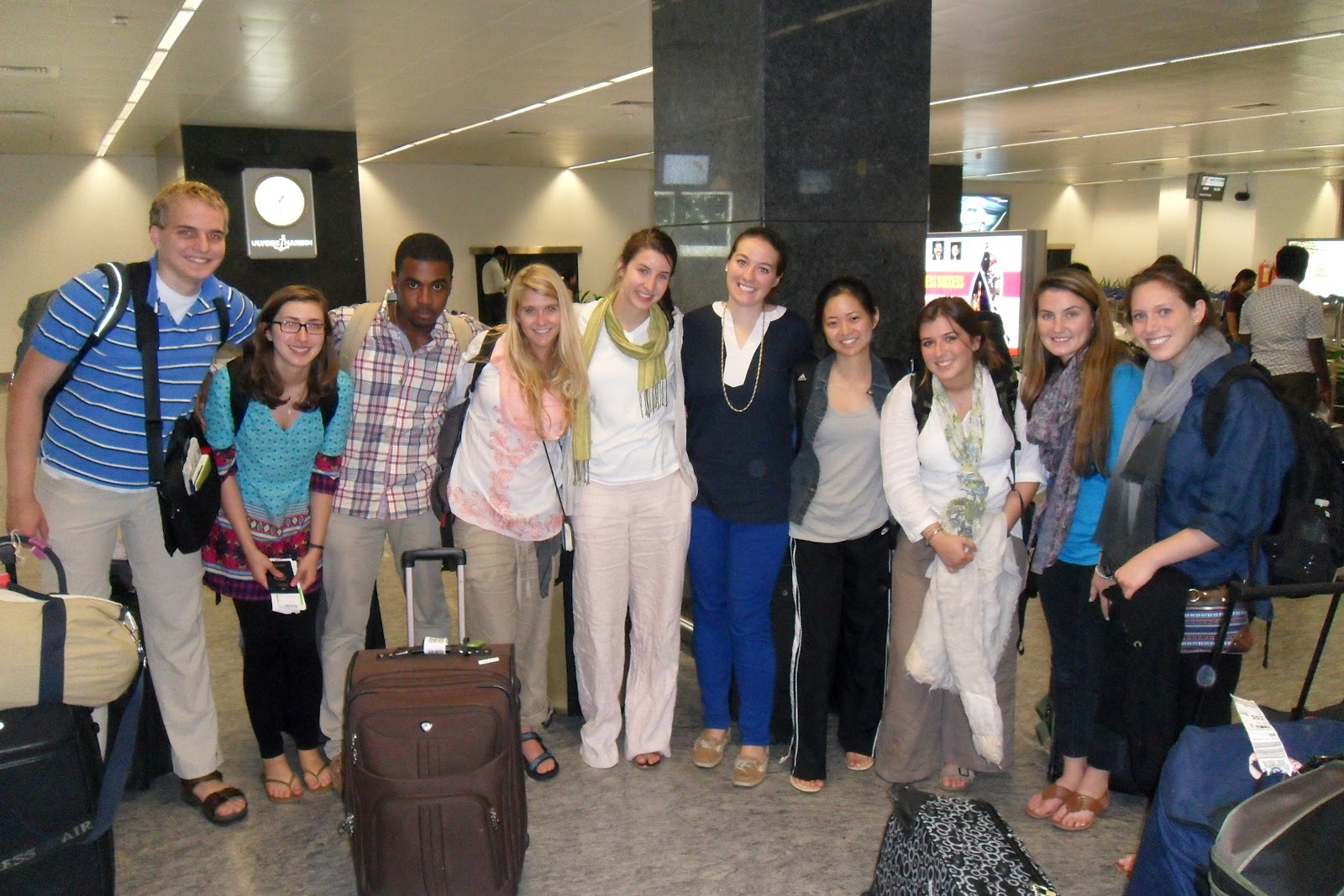
Greetings from India! The first group of ILR and Global Health students arrived at the Bangalore International Airport after midnight on May 27. After completing the immigration process and customs, they found the SVYM driver waiting to transport them to the main campus in Mysore--a 3 hour+ drive.
After months of preparation and visa stresses it was a relief to finally arrive in country! The following morning, SVYM Deputy Director Sindhu Suresh met with group to provide an informal orientation (the lovely formal orientation was held over the weekend), arranged for cell phones and sim cards (a great deal at $27 for a basic cell phone and card), and brought in a money changer who gave the students an excellent exchange rate of 44 rupees to the dollar. SVYM has made the group feel welcomed and comfortable--thank you to all!